


You’re halfway through installing a 1200 x 600 mm porcelain slab when you reach a soil pipe, a recessed socket box or an awkward internal corner. Straight cuts are predictable. Irregular shapes are not. One wrong move, too much pressure or a slight vibration at the wrong moment, and the tile fractures. With large format porcelain, that mistake can be expensive, frustrating and time consuming.
Understanding how to cut irregular shapes in tile, particularly in large format porcelain tiles, is no longer optional. Contemporary projects in the UK increasingly specify larger formats, tighter joints and more complex layouts. Precision cutting is now part of everyday work.

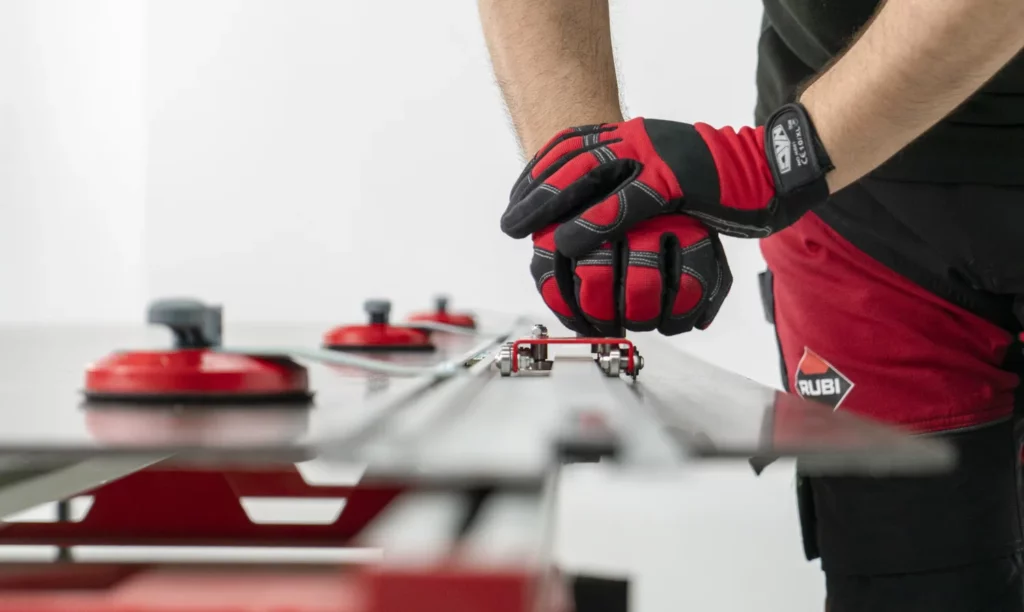
Why cutting irregular shapes in large format tiles is challenging
Size, thickness, and fragility of large format tiles
Large format tiles behave differently from standard 300 x 300 mm ceramics. Their dimensions amplify internal stresses. Even a minor torsion force during handling can propagate a crack across the entire tile.
Most large format porcelain tiles range from 6 mm to 12 mm thick. Thinner panels are more flexible but also more vulnerable to vibration and point loading. Thicker slabs are structurally stronger, yet harder to cut cleanly, particularly when creating internal cut-outs.
When cutting large format tiles, the issue is rarely the hardness of porcelain alone. It is the combination of density, size and unsupported sections that creates risk. An irregular cut introduces stress concentration points. If those are not managed correctly, breakage is almost guaranteed.
Common irregular cuts in real-world projects
On site, irregular cuts are rarely decorative. They are functional. You will typically encounter:
- Curves around sanitary ware
- L-cuts at door linings and boxed-in pipework
- Circular holes for pipes and fittings
- Socket and switch cut-outs in walls
- Notches around steel frames or structural elements
Each type introduces internal angles. Internal angles are critical because they act as stress multipliers. A sharp internal corner in porcelain is a natural fracture point if not relieved properly.
If you want a deeper breakdown specifically on curved work, our guide on How to Cut Curves in Tile: Tips and Tricks explores the mechanics in more detail.
Risks of breakage and costly material waste
Large format porcelain tiles are not forgiving. A failed L-cut often means discarding the entire piece. On high-end residential or commercial jobs, that can mean significant cost and delay.
Breakage typically occurs for three reasons: unsupported tile during cutting, excessive vibration from the tool, or forcing the blade through the material. In all three cases, the operator usually feels the resistance before the crack appears. Recognising that feedback is part of professional skill.
Essential tools for cutting irregular shapes accurately
Precision begins with the correct equipment. Standard small-format tools are not suitable when cutting large format porcelain tiles.
Manual and electric cutters for large format tiles
For straight scoring and controlled breaks, large format manual cutters still have a role. However, when irregular shapes are involved, electric cutting becomes essential.
A stable rail-guided wet saw system ensures straight, vibration-controlled cuts across long spans. Dedicated systems designed for slabs minimise flex and distribute pressure evenly. For heavy-duty and precision applications, professional-grade solutions within the electric cutting range provide the stability required for large panels.
Manual cutters are typically limited to straight scoring. Once you introduce internal corners or curved lines, you must transition to powered cutting.
Angle grinders and diamond blades for curved cuts
For curves and free-form shapes, an angle grinder fitted with high-quality diamond blades remains the most versatile solution.
The blade selection matters. Continuous rim blades reduce chipping on glazed porcelain. Turbo blades improve cutting speed but may increase edge roughness. For sintered stone or ultra-compact materials, a blade specifically designed for dense porcelain reduces microfractures along the cut line.
The key is not speed but control. Excessive RPM combined with aggressive feed pressure creates heat and vibration. Both contribute to edge damage.
Drill bits and hole saws for circular openings
When cutting circular openings for pipes or fittings, core drilling is preferable to attempting a plunge cut with a grinder.
Diamond hole saws create uniform stress distribution around the circumference of the cut. Drilling from the face with water cooling reduces heat build-up. For precise pipe penetrations, our article on How to Cut a Circle in Tile: Everything Pros Need to Know provides additional technical guidance.
Attempting to form circles by intersecting straight cuts introduces sharp internal angles. Those angles often become failure points once the tile is fixed.
Worktables and support systems for slab stability
Support is often overlooked. Cutting large format tiles on an unstable surface is one of the main causes of failure.
A rigid worktable with full tile support prevents flexing. When a tile vibrates mid-cut, the blade binds, and microcracks form ahead of the cutting line. Proper support systems effectively act as a stabilising platform, reducing torsional stress during cutting large format porcelain tiles.

How to cut different types of irregular shapes step by step
Cutting curves and rounded shapes
Begin by marking the curve clearly using a template or compass. Avoid freehand assumptions on high-value tiles.
Score lightly along the marked line with the grinder rather than attempting a full-depth cut in one pass. Multiple shallow passes reduce heat and vibration. As you approach the final millimetres, slow your feed rate and allow the blade to complete the cut without forcing it.
Where possible, relieve tension by removing excess waste in sections before finishing the final curve. This reduces the weight pulling against the cut edge.
Making L-cuts and corner notches
L-cuts are among the most common causes of slab failure. The critical mistake is cutting directly into a 90-degree internal corner.
Instead, drill a small relief hole at the internal corner first. This distributes stress and prevents crack propagation. After drilling, complete the two straight cuts up to the edge of the hole. The result is a radiused internal corner rather than a sharp angle.
Never attempt to snap out an L-shape after partial scoring. Large format porcelain does not behave like small ceramic tiles. It will fracture unpredictably.
Cutting holes for pipes, sockets, and fixtures
For pipe penetrations, measure carefully and double-check alignment before drilling. Start drilling at a slight angle to establish the cut, then bring the hole saw perpendicular once the groove is formed.
When cutting rectangular socket openings, drill each corner first to create relief points. Connect the drilled corners using controlled straight cuts with a grinder. This approach minimises internal stress.
Best practices to achieve clean and precise cuts
Measuring, marking, and planning the cut
Precision cutting starts before the blade touches the tile. Confirm all dimensions against the installed position, not just drawings. Walls are rarely perfectly square.
Mark clearly using a fine pencil or non-permanent marker. When cutting large format tiles, even a 2 mm miscalculation can result in visible misalignment across a wide surface.
Dry positioning the slab before final cutting allows you to confirm clearance and joint alignment.
Controlling speed, pressure, and vibration
Forcing the tool is the fastest way to ruin a tile. Let the blade cut at its designed rate. Excessive downward pressure increases friction and heat.
Maintain consistent RPM and a steady feed rate. If you notice vibration increasing, pause and check blade condition. Worn diamond segments reduce cutting efficiency and increase microchipping.
Reducing chipping on porcelain and sintered stone
Chipping is often caused by aggressive blade selection or inadequate support.
Use continuous rim blades for visible edges. Apply masking tape along the cut line if the surface glaze is particularly delicate. Most importantly, ensure the tile is fully supported beneath the cutting zone.
Cutting from the face side is generally preferable for finished surfaces, as minor edge imperfections will occur on the exit side.

Safety tips and common mistakes to avoid
Personal protective equipment and safe handling
When working with large format slabs, safety is not limited to eye protection. You should use:
- Safety glasses or face shield
- Cut-resistant gloves
- Hearing protection
- Dust extraction or respiratory protection when dry cutting
Handling large tiles also requires proper lifting technique or mechanical assistance. Twisting a tile while repositioning can initiate cracks before cutting even begins.
Mistakes that lead to cracks and breakage
The most common failures occur when the tile is unsupported near the cut line, when internal corners are not relieved, or when excessive force is applied mid-cut.
Rushing is usually the root cause. Large format porcelain rewards patience and controlled execution.
When to change tools or cutting techniques
If you notice excessive vibration, burning marks or irregular edge quality, reassess your setup. A worn blade, unstable work surface or incorrect tool for the material will only worsen the outcome.
Professionals adapt. Cutting large format porcelain tiles demands flexibility in technique depending on thickness, density and cut type.
Mastering how to cut irregular shapes in tile is about understanding material behaviour as much as mastering tools. Large format installations demand precision, planning and the right equipment to manage stress and vibration effectively.
When you combine stable support systems, high-quality diamond blades and purpose-built electric cutting solutions, complex shapes become controlled operations rather than risky guesses. That is where experienced installers gain efficiency and protect margins.
RUBI continues to develop cutting and handling systems designed specifically for large format porcelain and slab work, giving UK professionals the control required to deliver clean, accurate results on demanding projects.

Post a comment