


Porcelain floors fail when movement is trapped and stress is forced into rigid joints. Cracking, tenting and debonding usually start at restrained edges , long runs or poorly prepared transitions rather than in the tile itself. RUBI supports a more controlled approach to tiling movement joints, combining correct joint planning with accurate grout preparation and cleaning tools.

Why movement joints are essential in porcelain tiling
Porcelain is dense, rigid and unforgiving when movement is not managed correctly. In practice, the problem is rarely the tile alone; it is the interaction between the substrate, the adhesive bed and restrained edges. On larger formats and tighter joints, small dimensional changes can build enough stress to damage the installation.
What are tiling movement joints?
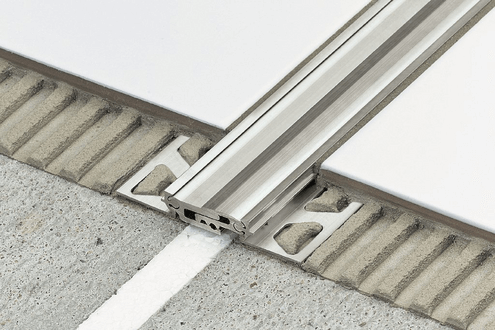
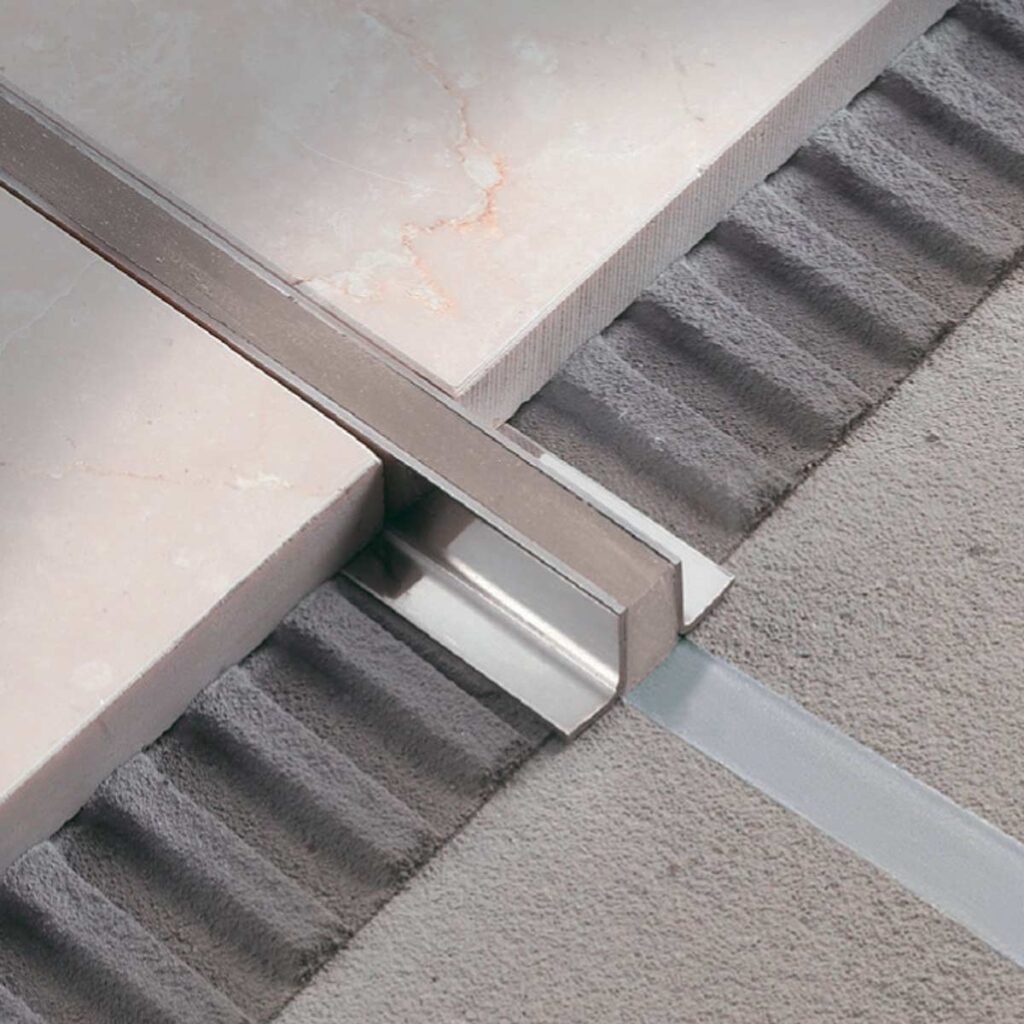
Tiling movement joints are deliberate breaks in the tiled surface that allow the assembly to absorb expected movement without transferring stress into the tile edges. They are part of the installation design, not a repair measure, and they must be carried through the tile layer and the adhesive bed where required.
Why porcelain tiles require movement joints
Porcelain tiles offer high strength and dimensional stability, but that does not remove movement from the rest of the build-up. Thermal change, drying shrinkage, deflection and transitions between materials still act on the installation. With large format porcelain, those stresses are distributed across wider spans, so movement accommodation becomes more critical, not less.
Common problems caused by missing movement joints
When joints are omitted, stress usually shows up as hairline cracking, loss of bond, grout failure or localised tile tenting. Trouble often starts at perimeters, internal corners, thresholds, structural lines or areas exposed to higher thermal gain. Once pressure is locked into the floor, regrouting alone will not solve the cause.
Movement joints vs expansion joints: understanding the difference
The terms are often used interchangeably on site, but they do not always describe the same thing. In floor tiling, clarity matters because the installer must distinguish between a joint already present in the structure and a joint required within the tile finish. The tiling layout has to respect both.
Expansion joints vs movement joints: are they the same?
Expansion joints vs movement joints is largely a matter of context. In everyday tiling language, many installers use both terms to describe joints that allow the surface to move. Technically, an expansion joint often refers to a movement provision in the building or screed, while a movement joint in tiling refers to the intentional jointing strategy within the tile finish.
Where each type of joint is used in floor tiling
Structural joints already present in the slab, screed or construction must be respected and continued through the tiled assembly. Floor tiling movement joints are then positioned at perimeters, around fixed penetrations, between fields and in zones subject to heat or differential stress. The key point is simple: the tiling work must not bridge a live movement line.
Where to place movement joints in floor tiling
Correct joint placement starts before the first tile is fixed. The installer needs to read the room, identify restraint points and understand where the substrate can move independently of the finished floor. Good joint planning protects the adhesive bed, the grout lines and the long-term appearance of the porcelain surface.
Floor tiling movement joints: positioning and spacing rules
Floor tiling movement joints should be planned to break the tiled area into manageable fields and to relieve stress at predictable locations. The exact spacing depends on the installation conditions, exposure and project design, but the principle remains the same: long uninterrupted runs of porcelain tiling increase the need for movement relief.
Perimeter joints, intermediate joints, and structural joints
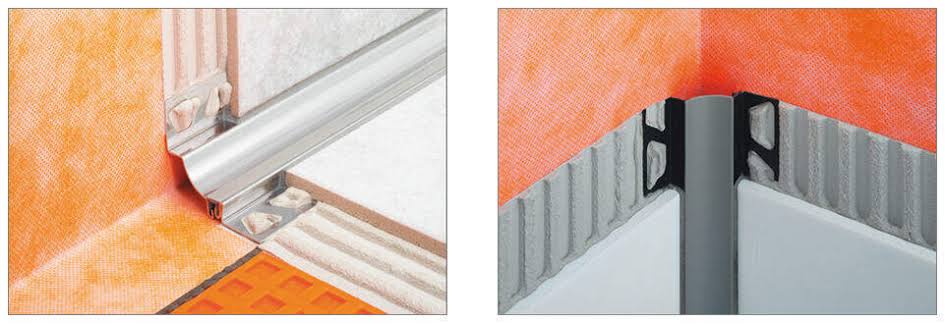
Perimeter joints isolate the tiled surface from walls, columns, thresholds and fixed upstands. Intermediate joints divide larger tiled areas into smaller fields. Structural joints in the building must never be covered over or treated as standard grout lines, because movement from the structure will pass directly into the finish.
- Perimeter joints: required where the tile finish meets restraining elements.
- Intermediate joints: used to reduce stress across larger tiled fields.
- Structural joints: must be continued through the tile layer and never bridged.
Internal vs external tiling considerations
Internal tiling still needs movement planning, especially with underfloor heating, direct sunlight or large-format porcelain. External tiling and highly exposed areas are more demanding because thermal cycling is greater and moisture variation is higher. In both cases, substrate condition and edge restraint determine how hard the tiled finish is being asked to work.

Grout selection and preparation for movement joints
Grout supports the finish, fills the visible joints and protects the installation from premature wear, but it is not a substitute for a designed movement strategy. The right choice depends on the project, joint width and expected service conditions. Just as important, the material must be mixed consistently so that workability, colour and joint compaction remain controlled.
Why grout flexibility matters in porcelain installations
Flexible grout is useful because porcelain floors are often installed with tight tolerances and limited forgiveness. A grout with some capacity to accommodate minor service movement helps reduce local stress concentration in the visible joints. That said, even a flexible grout cannot replace a true movement joint where the installation must open and close.
Cement-based vs flexible grout: what to choose and why
Cement-based grout remains standard for many projects, but the specification must suit the tile format, joint width and service conditions. Where the build-up is more demanding, a flexible grout offers a safer margin in use. The decision should be based on installation risk, not only on convenience during application.
Mixers and mixing paddles: how to prepare grout correctly
Consistent mixing is essential for clean joints and predictable wash-off. RUBIMIX mixers are designed for cementitious adhesives, resins, paints and other materials, with options such as the RUBIMIX-9 N at 1200 W and the RUBIMIX-16 ERGOMAX at 1600 W for more demanding mixing tasks. For tile adhesive and cement-based mortar mixing, RUBI also lists 3-helix paddles that improve efficiency, reduce vibration and can deliver a 15% performance improvement over 2-blade heads.
- Measure water accurately and keep every batch consistent.
- Use a suitable mixer and paddle to avoid lumps and trapped air.
- Mix to a uniform texture before application and avoid overwatering.
Applying and cleaning grout in large tiled areas
Large porcelain floors reward controlled grouting and disciplined cleaning. The objective is to fill the joints fully, remove residue without washing out the surface and maintain production speed across a broad area. That is where the right combination of grout floats, sponges, washboys and cleaning pads makes a visible difference.
Best tools for grout application and cleaning
For application, rubber grout floats remain the core tool because they compact grout into the joint without the scraping action of a metal trowel. RUBI lists several options, including RUBBER GROUT FLOAT SUPERPRO, THERMOFLEX RUBBER GROUT FLOAT SUPERPRO and SOLID RUBBER GROUT FLOAT SUPERPRO, plus PRO formats such as 24968 and 24969.
Using wash boys for efficient cleaning in large areas
On larger floors, a washboy keeps rinsing more controlled and reduces unnecessary water on the surface. RUBI lists the RUBICLEAN PRO WASHBOY with a 24 litre capacity and 17 litre useful capacity, as well as the RUBICLEAN EASYPRO WASHBOY with a 24 litre capacity. Paired with the correct sponge float, this helps maintain cleaning rhythm without flooding the joints.
Cleaning pads for final finishing and residue removal
For final residue control, RUBI lists the FLOAT + 3 MIXED PADS SOFT/MEDIUM/HARD Ref. 20900 and the FLOAT + 3 VERY SOFT PADS Ref. 20944, both in the 25 x 10 x 2.5 cm format. These are intended for cleaning ceramic surfaces and other materials, with replaceable pads in different roughness grades to adapt the finish to the surface condition.
- Rubber grout float for packing the joint diagonally and removing excess.
- Washboy and sponge float for controlled rinsing on larger tiled areas.
- Cleaning pads Ref. 20900 and 20944 for final finishing and residue removal.
Can grout replace a movement joint?
This is one of the most common on-site misunderstandings. A grout line may look like a joint, but function matters more than appearance. If the installation needs a space that can accommodate opening, closing or differential movement, a standard grouted joint is the wrong detail.
Why grout alone cannot absorb structural movement
Grout is a finishing and joint-filling material, not a structural movement detail. Once cured, even a more flexible grout cannot perform like a dedicated movement joint designed to accommodate ongoing movement. Where the substrate, perimeter or structural line needs relief, replacing that detail with grout simply transfers stress back into the tile assembly.
Best practices for long-term stability in porcelain tiling
Long-term performance comes from system thinking rather than isolated product choices. The substrate has to be sound, the adhesive has to be appropriate, joints have to be planned and the grout has to be mixed and cleaned correctly. Professional results are usually the outcome of many small correct decisions, not one single product choice.
Preparing the substrate to accommodate movement
Substrate preparation is the first control point. The floor must be stable, clean and suitable for the intended tile format, and existing movement lines must be identified before setting out. On larger porcelain work, the installer should also consider tile size, notched trowel choice and adhesive coverage, because a stressed or inconsistent bed makes movement-related failures more likely.
Installing movement joints correctly on site
Movement joints should be kept clean, correctly located and protected from accidental filling with adhesive or grout. At perimeters and transitions, the tiled surface needs enough freedom to move independently of restraining elements. The finish may look simple, but the joint detail must remain functional throughout the full service life of the floor.
Common installation mistakes to avoid
The most frequent mistakes are easy to recognise: bridging a structural line, grouting tight to the perimeter, treating every visible joint the same, or assuming that a stronger grout will solve a movement problem. Another common issue is poor mixing and over-washing, which weakens the joint finish and leaves avoidable cleaning residue on porcelain surfaces.
- Do not bridge structural joints with tile, adhesive or grout.
- Do not grout hard against perimeters, thresholds or fixed penetrations.
- Do not use grout as a substitute for a designed movement joint.
Why professionals rely on proven tiling systems and tools
Professional tilers do not separate technique from tooling. Reliable mixing, controlled adhesive application, proper grouting and disciplined cleaning all contribute to a floor that performs over time. RUBI supports that workflow with dedicated systems for mixing, tile fixing, grouting and cleaning, allowing installers to keep quality consistent across domestic, commercial and large-format porcelain work.
Frequently asked questions about tiling movement joints
These are the questions that usually come up when porcelain floors are being planned or when failures appear after installation. The answers are practical: movement joints are about risk control, not about adding unnecessary complexity. In most cases, the safest approach is to treat movement planning as part of the installation system from the start.
How often should movement joints be installed in tiled floors?
Movement joint spacing depends on the project conditions, field size, exposure, heating and substrate design. What matters most is that long runs, restrained perimeters and structural lines are addressed before tiling starts. The installer should always follow the project specification and relevant British Standard guidance for the application.
Are movement joints required for small rooms?
Yes, because even where a field joint is not needed, perimeter movement is still required. Small rooms can still suffer from restraint at walls, thresholds, boxed-in details or heated zones. A compact floor does not remove the need for movement accommodation; it only changes where that movement is managed.
What happens if movement joints are ignored?
Ignoring tiling movement joints increases the likelihood of cracked grout, debonded tiles, edge compression and visible tenting. On porcelain floors, the finish may appear sound at handover and then fail later as stress accumulates through service conditions. In other words, the job can look complete while the failure mechanism is already built in.

Post a comment